Search This Blog

THE HORROR STRUCTURE: EXTERNAL CONFLICT SCENES

After picking a subgenre of horror to play with. It is time to put your story idea through its paces to see if you have enough material to turn it into a 400 page book. I put every book idea through this process and if I can't come up with 40 sentences, then I let it percolate a lot longer before I start writing it or decide it doesn't have enough raw material and discard it. You can read more about my process here.

External Conflict scenes follow the effects of the evil on the entire cast or story world.

The intent of these scenes is to scare the pants off of your readers. You have to confine them, torture them with something suspected but just out of sight. The menace has to be believable and constitute a mortal threat to one, some or all. Panic rises. Suspicion shifts.

In these scenes, the protagonist and/or victims are chased down a dark corridor, finds the journal with the ghost’s picture, or searches the library for who used to own the creepy house. They get locked in the cellar by the demon as the house goes up in flames.

In the final external scenes, the threat is removed, unless it is banished to return in the sequel.

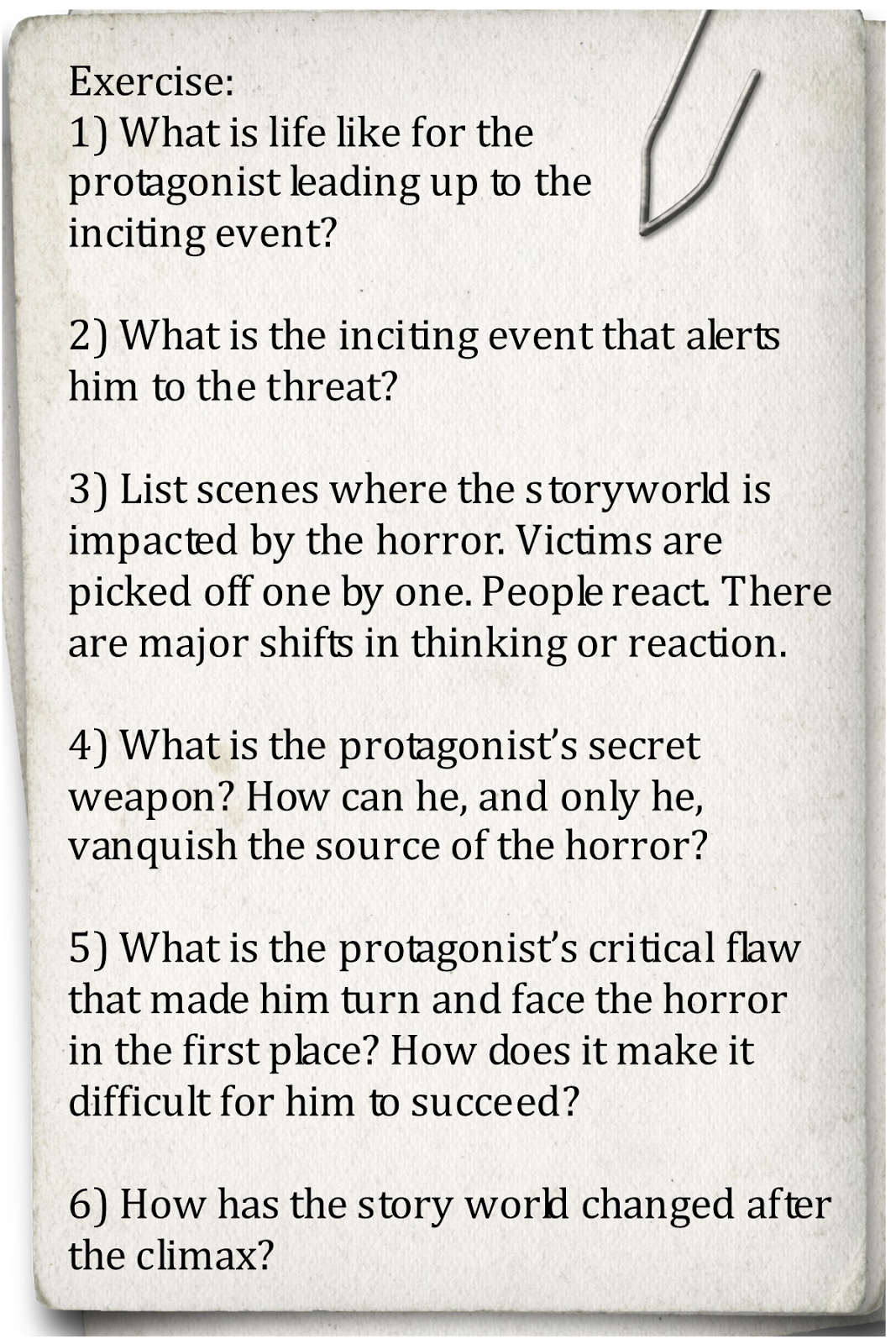
List ten scene ideas for how the protagonists and the rest of the cast confront the evil, gain ground, lose, then win (or lose?).


For more about how to craft plots using conflict check out, Story Building Blocks: The Four Layers of conflict available in print and e-book and check out the free tools and information about the series on my website.

THE HORROR STRUCTURE: SUBGENRES

No story makes your skin crawl more than the horror story. The horror story takes suspense to a higher, usually more explicit, level and generally contains more graphic material than the Thriller.

The overall story problem in this genre is a mortal threat to an individual or group. Therec can be a mystery at the heart of it, but it is separate from the mystery genre.

Antagonists include the abnormal and paranormal: ghosts, zombies, vampires, serial murderers, killer sharks, giant spiders, viruses, vampires, werewolves or clowns. The antagonist must be nearly impossible to beat and to fail means death. 

The reader expects to be not only thrilled and anxious, but horrified and you need to start from page one. You can start slow and build on the horror, but true fans won’t appreciate a slow, horror-free build-up to a final, horrible truth.

The point of the Horror story is to make the readers squirm, scream, and confront their fears either individually or as a group. The fears can be everyday things such as fear of being alone, of the dead, of the unknown, or of the dark. The horror genre magnifies our fears so we can examine them safely.

There must a sense of being trapped in a room, a house, a town, or on a planet that you can’t escape and therefore must turn and face the threat. 
It’s scariest if the reader doesn’t know where the threat is hiding or where it will strike next. It’s that feeling of “there’s something in the dark, I can’t see it, how can I protect myself from it?” that preys on our elemental fear of being defenseless.

It can also be the “who will die next” plot.

The reader asks: What brought the danger near and how will they get away from it?

There are several subgenres of horror from suspenseful to gruesome.

Alien Horror takes Science Fiction to a darker place. The source of the horror is either on another planet or something brought to Earth from outer space.

Creepy Kids Horror features children who turn out to be evil, possessed by demons or Satan himself.

Erotic Horror features explicit content: sadomasochism, torture, the dark side of sexuality and the sex trade.

Extreme Horror contains explicit violence and is often a “who dies first plot” with no real rhyme or reason other than to kill the victims off in horrendous fashion.

Holocaust Horror contains mass deaths, either in the past or future. They can be due to human slaughter, a rogue virus, monsters, zombies, etc. They are often dystopian or post-apocalyptic settings.

Humorous Horror combines the horror structure with the comedy structure. It is scary, but also funny.

Mind Control Horror plays on our fear of not being in control – especially of our own minds. The mind can be taken over via sorcery or via technology. Victims are forced to act against their will and nature and are horrifying aware of it – unlike a mindless zombie.

Noir Horror
uses a gritty, urban setting with cynical protagonists who must fight the horror facing himself or everyone.

Paranormal Horror
features a mortal protagonist who must fight off immortal or supernatural threats. These include exorcist tales, possession, ghosts or demons.

Psychological Horror keeps the verbal camera in tight focus on the protagonist. He and the audience are kept in the dark. They aren’t certain what they are fighting until the end. This subgenre can also follow the evil or insane protagonist such as a serial killer, where the protagonist actually turns out to be the antagonist.

Rampant Technology Horror examines our fears that man has gone too far in their technology or achievements. It can feature monster toasters or robots that kill. It can be the ghost in the machine or the machine that steals your soul.

Satanic Bargain Horror features a protagonist who strikes a deal with the devil, like Dorian Gray. They end up paying a horrible price for their decision.

What are your favorite horror subgenres? 
Can you think of others? 

You can learn more about the genre through Horror Writers Association at http://horror.org/ 

You can join their group on Facebook group at https://www.facebook.com/groups/Horrorwritersassoc/.

For the month of October, we will examine story building block layers as they pertain to the horror genre.

For more about how to craft plots using conflict check out, Story Building Blocks: The Four Layers of conflict available in print and e-book and check out the free tools and information about the series on my website.

Minding Your Manners

#storybuildingblocks,@diana_hurwitz,#writingtips,#fiction,#screenplay
www.dianahurwitz.com
I give credit to an article in Parents magazine for inspiring this one. Are etiquette and chivalry truly dead? In your story world, you decide. 

Tweet: Mores and manners change with the times, but everyone has a set of rules. #writingtips

From knights in clanging armor, to Victorian parlors, to the craziness of Hollywood, every story world has a set of rules for how people are supposed to behave and whether or not your characters choose to.

How comfortable Dick is in terms of asking for something depends on his personality type and whether he likes the person he is asking. The polite way to ask is, "Please may I ...". If Dick says, "Please taking a running leap off a short pier," the game is on.

How comfortable Dick is in terms of receiving things also depends on his personality type and whether or not he wants the item received. 


Thank you's when used appropriately, are the oil that makes life run a little smoother. An insincere thank you can mask anger when Dick would really like to let those rude words fly and can't. "Why thank you! However did you come up with such a creative solution to our current predicament ...Sweetie." If he says, "Thank you for not breathing," the game is on.

When a character interrupts a conversation, even to tell Dick that Timmy is in the well, he is being rude.


How often do your characters interrupt each other? Is it well meant, deliberately intrusive or because the situation requires it? Is it timed to deflect an important or revealing conversation?

Cell phones are rampant. Forcing the people around him to listen to Dick's conversation is rude. Listening in on other people's conversations is considered rude. This can also have unforeseen consequences. People aren't careful when they talk on their phones in public. They aren't careful when dining with their friends in restaurants. Clues can be dropped, sensitive information revealed and a person's true colors exposed.

"It's better to ask permission than forgiveness" is a current favorite. But is it? Sometimes Dick should ask permission, like before he raids someone else's refrigerator. He'll pass on asking permission if he is raiding their safe. Taking something innocent without permission may seem harmless, but may push the wrong button. How does Dick feel about having something taken without permission? Is he amused or furious?

Jane should keep negative opinions to herself. Or between her and her friends and out of earshot of other people. In which case, they can discuss freely and at length over their favorite beverage. Refer to the previous "there's no privacy while dining" scenario. This is especially true when commenting on other people's physical characteristics, clothing, possessions and children. It isn't considered acceptable to offer an insult as a compliment: "My, those tattoos are so colorful." Or "It must have taken hours to do that to your hair." Southern women are queens of the insult/compliment smashup. "Well, bless her heart, isn't she precious? It must have taken a month of Sundays to come up with that outfit."

Jane should take a hostess gift to someone's house when invited for dinner and thank them for having her over and for the good time she had. If Jane is lying through her teeth, you have conflict. If she takes them a present intended to insult, the game is on. Is she thanks them for the most riveting evening she's ever had, the insult might fly right over her host's head.

Sally was taught to knock before entering. This could avert a potential disaster if her husband is in bed with someone else. If she is doing something she doesn't want anyone to know about, locking the door would be a great idea. If Sally never locks a door and suddenly decides to lock the door, there is conflict. Locking the bathroom door could mean the child/person knocking better be bleeding, the house on fire or someone dying. If not, the game is on.

When making a phone call, Dick should introduce himself and ask for whoever he wishes to speak to. With the advent of caller ID this is going out of fashion. The conflict occurs when Dick doesn't bother to ascertain who he is talking to before he speaks. It also occurs when Dick answers someone else's phone, particularly if he pretends to be that person. Wrong numbers and misunderstandings are rife in these situations.

What are your story world rules about profanity? It is considered bad manners to use foul language in public, particularly if sensitive little ears are around to hear them. There are still factions of society insulted by words that other factions of society use as versatile adjective/noun/verbs. Profanity is generally considered crass in business and social functions. If Dick does so, how much trouble will he be in? Is Jane offended by profanity or does she swear like a sailor?

Dick should never call other people names or make fun of them. Until they are out of earshot and can't hear him or retaliate. Unless he intentionally wants to start a fight. Even good natured teasing can be taken the wrong way.

Jane should sit through a play, assembly, lecture or business meeting quietly and pretend she is interested even if she is bored silly. What happens if she doesn't? We've all been in boring business meetings, school music programs or dance programs that - other than our little darling's five seconds of fame - bore us to tears. You may be at a lecture or a workshop. This is where the cell phone issue comes in. The light from the screen is distracting. Jane may be bored, but the parent/participant sitting next to her might not. What happens if Jane is forced to sit there? What happens if she breaks free? What happens if she breaks out her Blackberry?

Sally should cover her mouth when she coughs or sneezes. These days it's an act of terror to spread germs in a public place or airplane.

If he sees someone struggling, Dick should offer to help. This is lovely if an elderly person is struggling with their groceries, a mom with a stroller, or someone drops something and doesn't notice. These situations can be hilarious or deadly. What could a little act of kindness lead to? What could Dick gain by pretending to be helpful? There's the old joke about the boy scout who helped the old lady across the street only to find she was headed the opposite direction. Good intentions rarely go unpunished.

When someone asks a favor, Jane should do it without grumbling, unless the favor is inappropriate. Favors can be dangerous. If Jane asks a favor, she should preface it with, "Would you mind." If she follows that up with "Would you mind sodding off?" the game is on.


For more on crafting conflict to create tension, pick up a copy of Story Building Blocks II: Crafting Believable Conflict available in paperback and E-book.

The Importance of Reputation


Tweet: There was a time and place when a man was only as good as his word and integrity was paramount. #writingtips

A clansman's oath was to the death. Tribesmen the world over made verbal contracts often involving an exchange of blood.


If you lived in merry old Europe during most of the regent-named eras, a reputation was considered more important than currency. A man might be poor, but he could still have his good name. Lots of citizens indulged in lascivious shenanigans, though most turned a blind eye while they did so. As long as the shenanigans took place in private and the “public” remained ignorant, all was well and good. Shift the curtains and allow a passerby to see inside the facade and the person in question was ruined.


Are honesty and integrity important in your story world? Is it more valuable than currency? 

Is it important for Dick to have a “good name?”  What will Dick have to do to maintain or regain his reputation? Many a tale hinges on someone trying to repair a damaged reputation. Dick’s integrity might be one of his hot buttons. Others will challenge it at their own risk.

Dick might be proud of his reputation as a womanizer and guy’s guy. Jane might look down her patrician nose at him for being so superficial. In many a love story, she finds out her initial prejudice was unfounded.

Jane might have a reputation as a loose woman with a sharp tongue. When forced to work with Jane, Dick might realize Jane has been unfairly demonized. She is really quite lovely.

How important are honesty and integrity to the characters that move about your story world? 


Not all of them will value the same things. To some, virtues will be of the highest importance. To others, vices might be of higher importance.

Is it better to give than receive? Depends on who is giving and who is receiving, doesn’t it? If Dick is giving money to a charity, it’s a good thing. If Jane is giving crucial intelligence to Iran, not such a good thing. Both might have a reputation as a “giving” sort of person.

What if Dick has earned a reputation he does not deserve? What if he is held aloft and admired by millions for something he didn’t really do, or for doing something that appeared benign when it was secretly malignant?

It might be Jane’s story goal to strip him of his “good name.”

A business’s reputation is worth its weight in stocks. A single incident can trash a business’s reputation. The business may never recover. The stakes are high when a company is fighting to keep, change, or restore its reputation. Those at the top of the corporate pyramid may turn lethal if their reputation is challenged. If Dick orchestrates a coup with the sole purpose of destroying a corporation, the game is on.


#writingtips,#fiction,#screenplays,#worldbuilding
www.dianahurwitz.blogspot.com


To learn more about the mannequins and how personality types create conflict for your characters, pick up a copy of Story Building Blocks II: Crafting Believable Conflict, available in paperback and E-book, and Story Building Blocks: Build A Cast Workbook available in paperback and E-book.


Stirring The Plot: Physical Obstacles

Physical obstacles prevent movement, communication, access to a person, the retrieval of an object, and necessary exchanges. 

Physical distance prevents access which increases tension.

Time limits put the tension level at full throttle.

These are the types of action scenes that leave your readers biting their nails. The harder the task, the greater the anxiety level for the reader.

1. A physical barrier, like having to break into a safe or out of a cell.


This is a key tool in every genre from thriller t0 romance. Yes, romance. In the Outlander series, there are numerous times when Jamie and Claire must rescue one another from captors. And what is a heist movie without obstacles to the theft?

2. A situational barrier, such as trying to enter an area that is off limits.

Whether you character succeeds through sweet talk or stealth, waiting for them to get past this barrier can be funny, thrilling, or heartbreaking.

3. Physical restraints, like being stuck inside a car, plane, or train. 


Or trying to break free from handcuffs or a straight jacket. Your character does not have to be a magician to use this tool. They can be tied up or boxed in. Everyone can relate to the need to escape.

4. Missing the target whether it is a boat, train, airplane, or opportunity.


This is another situation your audience can relate to. The nearer the miss, the higher the tension. Will they get another chance or have to find another way?

5. Limited mobility due to a temporary or permanent physical disability.


Self-healing thriller characters aside, when your character is shot, stabbed, or otherwise hobbled, they will have difficulty doing what comes next.

6. Misunderstanding the time frame involved or being given an impossible timeline.


The ticking clock is arguably the most intense tool in the tension toolkit. There must be an "or else" for it to work properly. Nothing is worse than setting a ticking time bomb that doesn't go off.

7. Physical distances that make accomplishing the task difficult or impossible.


Whether you character has to traverse a hall, a flight of stairs, an eighty-story building, or rush from country to country, your readers feed on the the adrenaline rush your character experiences as he tries to accomplish the impossible.

8. Being misled about the correct destination.


Friend or foe, antagonist or love interest, missing the bus gives your readers a feeling of let down. They can relate to that moment when you realize you've taken the wrong turn, the wrong plane, or walked into the wrong bar.

9. Not being able to touch.


Truly, nothing is more agonizing than watching characters who desperately want to touch each other being kept apart. It can be lovers who are forbidden to love, or a mother reaching for a child who is slipping through her hands, literally or figurative. It can be the grieving loved one trying to reach the dead or dying. This tool can gut your reader or fill them with longing.

10. Different places or times.

This tool works best in the science fiction and fantasy realms where characters are literally worlds or time periods apart. From Diana Gabaldon's Outlander series to the movie Somewhere in Time, nothing keeps people apart more effectively than being in different eras. Your characters can be placed in different planets, starships, or fairy realms. Your readers will hang on to find out how they resolve these great distances.

For more about how to craft plots using conflict check out, Story Building Blocks: The Four Layers of conflict available in print and e-book and check out the free tools and information about the series on my website.

Stirring the Plot: Ability Obstacles


Ability obstacles are created by a character's need to decide what to do, form a plan, and take the necessary action. Some are able to make a plan and stick with it. Others prefer to wing it. Some make quick decisions. Others dither. Pairing opposites to get the job done creates conflict.

Every character has strengths and weaknesses. He has areas of expertise and areas of ignorance. When action needs to be taken, different characters take it in different ways.

Let's look at ten ability obstacles.

1. A character lacks the strength or expertise to perform a physical or mental task.

2. He struggles with forming a plan and seeing it through. Planning may not be one of his strengths or his need to have a plan can keep him from taking action on the fly.

3. He does not have enough or has too much time to think it through. The more a character needs time to process, the more anxious he becomes when under the gun. Does he scatter or can he pull it together?

Some characters struggle with spontaneity, others are chronically impulsive. Sometimes having too much time to think can give the character a chance to doubt the wisdom of his choice.

4. Characters differ in their approach to the problem.

Characters with differences in problem solving methods will clash. Whose method is better? Which will work in the specific instance? Can they balance each other out and succeed or drill holes in the boat and sink the effort? One needs to have a plan, another wings it. One needs to be sure of the outcome, the other doesn't care. He will build wings on the way down.

5. His natural approach fails and he must rely on his weak side.

Giving your character a task that requires him to use his weaknesses can be an opportunity to show growth.

6. He tries the opposite approach and it backfires.


Use this when you want a spectacular failure during the time when it appears all is lost. He can then tell his partner: "I told you so."

7. He invests effort in the wrong solution and fails. 


During the early part of the story, this tactic is often used. The character thinks he knows what the problem is, who the bad guy is, or where the problem lies. He wastes the first half working toward the wrong goal. At the appropriate turning point, he realizes his mistake and recalculates.

8. He is uncomfortable deciding


Your character's inability to decide can be his worst nightmare or a silent strength. Perhaps he holds back while everyone else rushes ahead and ends up being the only one left standing. He can be pushed by others into the wrong job, the wrong relationship, or the wrong cause. He can act as sole voice of reason. Others will be irritated with his dithering, but his dithering can result in him being the only one to see clearly. Or it can simply cause passive-aggressiveness that drags out the conflict.

9. His timing can be off. He decides too soon or too late.

His amorous attempts can be too little to late or he can come through at the very last minute and change his love interest's mind. He can choose the wrong girl, then meet the right one. He can decide to join the battle too late and strike out on his own to rectify his mistake. Deciding too late could save him from being collateral damage so he can solve the problem on his own.

10. He just wants the problem gone and takes the wrong action.


This is useful in the early part of the plot where you want things to go wrong for your protagonist. A story problem arises, so he make a snap decision or makes a wrong move. This sets up the conflict for the next act. He must spend the saggy middle cleaning up his mess and choosing a new course of action. This course of action often fails as well and he finds the right path in the final act.

For more about how to craft plots using conflict check out, Story Building Blocks: The Four Layers of conflict available in print and e-book and check out the free tools and information about the series on my website.

Stirring the Plot: Knowledge Obstacles

#writingfiction, #writingtips, #fiction, #critiquegroup, #genre, #novel, #storybuildingblocks, #screenplay, @Diana_Hurwitz,  #temperament, #storybuildingblocks
At each stage of the story problem, you have to decide what your character knows, when he knows it, how certain he is, and how hard it would be to convince him he is wrong.

Knowledge obstacles prevent understanding and complicate communication. 

How do your characters communicate?

Do they ask questions or give orders?

Do they listen to answers or brush them off?

Higher education teaches characters to think and debate, rarely does it teach them to get in touch with their feeling side. When it comes to our sweet sixteen, each could strengthen his weak side.

In previous posts, we discussed persuasion plot holes. Knowledge obstacles can create internal and interpersonal conflict. They often require your characters to persuade another to their way of thinking. When they are presented with knowledge obstacles, they can be forced to use persuasion tactics.

1. Missing information.

Some characters are fine with proceeding without all of the information. Others need lots of data to make decisions. Forcing opposites to work together or placing a character in a situation where they need to act outside of their comfort zone increases the tension.

2. Conflicting ways of obtaining information.

Some characters prefer facts, others prefer impressions. The dichotomy between solid and fuzzy data will make different characters uncomfortable. Pair opposites or force your characters to require the opposite of what they rely on. They can argue whether the information obtained was obtained correctly or incorrectly based on their opinion.

3. Receiving the same information but interpreting it differently.

Your characters can look at the same collection of facts, figures, or opinions but have completely different reactions to them. Their differences of opinion can cause low-level or explosive conflicts.

4. Conflicting information.

Information can come from conflicting resources, multiple resources, or inaccurate people. Muddying the waters will make some characters more uncomfortable than others. It will come down to who they trust or who they believe. How much do they like the person? What do they want to hear or believe? When the facts don't add up, it creates dissonance.

5. Inaccurate information.

Characters can be intentionally or unintentionally misled. How they feel about going forward with faulty information can result in guilt, recrimination, or resentment. It can result in a failure to meet their overall story or scene goals. This results in a need to gather new information or take action to fix the problem it has created. This moves the plot forward.


6. Inability to understand the information due to language differences.

Whether you are talking Mars and Venus, different ethnicity, or alien versus human, not being able to communicate effectively creates conflict. Attempts to overcome these differences can be comic, poignant, or frustrating.

7. Inability to deliver an important piece of information.

Your character can meet many obstacles when he needs to impart crucial information to another character. It could be lack of cell phone signal, being bound and gagged, or being physically prevented from approaching his target.

8. Knowing something he doesn’t want to acknowledge.

This can be a harsh reality for your character. As long as he refuses to accept the truth, he will be unable to solve the issue at hand.

9. Communicating what they know.

This comes back to persuasion techniques. He may not be taken seriously by his audience. He may not be considered a valid source of information. He may not be in a state to inspire confidence in his rantings.

10. Who he chooses to tell.

Your character can refuse to talk unless he is allowed to speak to someone he trusts. He can trust the wrong person. He can withhold important information which can lead to further conflict.

11. How and when he chooses to tell.

Delivery is half the battle. Does he try to appease or inflame the audience? Has he picked the worst possible moment to drop his bomb? Has he reached a point where he just can't keep the information to himself any longer?

Read more about persuasion techniques and pitfalls:

The Persuasion Plot Hole

Persuasion Tactics Part 1

Persuasion Tactics Part 2

Persuasion Tactics Part 3

For more information on crafting characters and plots check out my website and pick up a copy of Story Building Blocks II: Crafting Believable Conflict in print and e-book.