Search This Blog

Showing posts with label #mystery. Show all posts

The Cozy Mysteries of Andrea Penrose

I am always thrilled to discover a talented author with a series I haven't yet read. I buy the back list and settle down for hours of enjoyable reading.

This year, I discovered Andrea Penrose and her two cozy mystery series set in Regency London. If you are fans of Tasha Alexander's Lady Emily series, Deanna Raybourn's Lady Julia Grey series and Veronica Speedwell series, and Anna Lee Huber's Lady Darby series, you will love Andrea's books. I love the cast, the setting, and the plots. I forgive the few crutch words such as conundrum, dastard, and snick snick. Writers all have them. Mine changed with each book.


The first book I read was Murder on Black Swan Lane from Penrose's Wrexford and Sloane series. The cast is unique. The lady sleuth, artist Charlotte Sloane, secretly skewers popular society with her pointed lampoons. The Earl of Wrexford is a gentleman scientist. A creative crime-solving posse makes or breaks a cozy series in my opinion and this series has one of the most delightful. Charlotte has adopted two street rats, Hawk and Raven. Wrexford has worthy allies in his valet Tyler and housekeeper McClellan.Then there are Wrexford's friends Sheffield and Cordelia. Finally, there is Henning, the doctor who performs postmortems. Thanks to run-ins with a Bow Street Runner, Mr. Griffin, they are never short of mysteries to solve. There are currently seven titles in this series and I hope it continues long into the future.

The newest Wrexford & Sloan will be released  September 26, 2023 
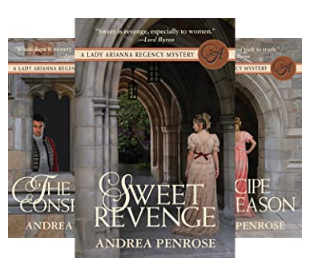
When I finished the Wrexford and Sloane series, I embarked on the Lady Arianna Hadley series. Thanks to her disgraced aristocratic father, Arianna had quite the swashbuckling past. Removing them from the strictures of polite society makes her characters far more interesting. Arianna is a master of disguise with a talent for mathematics. She returns to England to get revenge. Her love of chocolate makes her a suspect in poisoning the Prince Regent which brings her into contact with the Earl of Saybrook, an expert on chocolate tasked to find the culprit. I love the extended cast in this series too. The couple becomes embroiled in many cases to save the fate of the country thanks to their spymaster frenemy, Lord Percival Grentham. Saybrook’s great aunt Constantina, the dowager Marchioness of Sterling, is a fun member of the sleuthing team too. They gather enemies and allies throughout the seven book (hopefully continuing) series. My only complaint is that it makes me crave chocolate.

Lady Ariana's seventh mystery was released on March 22, 2022:
https://www.amazon.com/Swirl-Shadows-Arianna-Regency-Mystery-ebook/dp/B09MY8P6MW

So grab a cup of your favorite hot beverage, be it tea or cocoa or coffee, and settle down for an enjoyable adventure in the story worlds of Andrea Penrose.

Hint: Books make great gifts.

Andrea Penrose Books on Amazon
Andrea Penrose on Facebook
Andrea Penrose on Twitter 

Andrea's Website http://andreapenrose.com/

Agatha Christie And Then There Were None

Agatha Christie is a grand master of mystery. She specialized in the locked house mystery and "who will die next" formula. My mother was a huge mystery and horror genre fan. And Then There Were None was both. I began reading Christie's books at age eleven and reread them occasionally today. 

*** SPOILER ALERT***

To begin, a group of seemingly random people arrive at a remote manor home on a deserted Island for a party. 

“Best part of an island is once you get there - you can't go any farther...you've come to the end of things...”

As the bodies pile up, backstories and the reason for their attendance is revealed. Each has been found guilty of a crime decided by a judge of one and have been invited to their own execution.

"There was a silence—a comfortable replete silence. Into that silence came The Voice. Without warning, inhuman, penetrating . . . “Ladies and gentlemen! Silence, please! . . . You are charged with the following indictments.”

Christie writes in third person omniscient. The writing is spare. Descriptions kept to a minimum. The audience is clued in to the connections and murder accusations one at a time. There is a poem about Ten Little Indians that hangs in each bedroom, a template for what is to come.

"There was no one on the island but their eight selves."

Each guest has a secret, but not all of them carry guilt. Their crimes are revealed one after the other.

“But it does come! The blessed relief when you know that you’ve done with it all—that you haven’t got to carry the burden any longer. You’ll feel that too, someday…”

The tension comes from the "who will die next" aspect, the claustrophobia of no escape, and the paranoia and fear created by not knowing where the monster is and when it will strike next. This is a critical technique to keep in mind when writing horror.

“I don't know. I don't know at all. And that's what's frightening the life out of me. To have no idea....” 

If there is a weakness, it is that some of the "crimes" were sort of soft crimes: negligence or incompetence. The victims are not all guilty of atrocity, so the justice is a little unbalanced.

"I must say that I watched the faces of my guests closely during that indictment and I had no doubt whatever, after my long court experience, that one and all were guilty."

In addition to the stage play and movies based on the actual novel, her techniques have been utilized in countless mystery and horror novels and films. She also utilized a poem in Crooked House, another technique worth borrowing. New adaptions of Christie novels into movies have been filmed in recent years and the series continues.

I incorporated a few of the techniques in Mythikas Island. My characters are on a deserted island with no way off and no foreknowledge of the dangers they face. Secrets are revealed. Suspicion and paranoia heighten the tension. 

And Then There Were None was published in 1939. You can pick up a copy here. One of Christie's books still sells every seven minutes. That is the type of immortality writers strive for. 

Christie's son decided to allow author Sophie Hannah to continue his mother's legacy. She has written new "Christie" novels resurrecting the cozy sleuth Hercule Poirot in a new series

Hercule Poirot's Silent Night: A Novel 

Closed Casket: A New Hercule Poirot Mystery

The Mystery of Three Quarters: The New Hercule Poirot Mystery 

The Killings at Kingfisher Hill: The New Hercule Poirot Mystery

I have not yet read the new series. I have to admit I have mixed feelings about someone taking on another writer's character and world, especially when they aren't around to object or approve. But Sophie Hannah is a good writer of her own material. So you can decide for yourself.

I highly recommend studying Christie for story structure. For my dissection of another of her works, Crooked House, check out this six post series on Dissecting Christie.

Dissecting Christie Part 1

Dissecting Christie Part 2

Dissecting Christie Part 3

Dissecting Christie Part 4

Dissecting Christie Part 5

Dissecting Christie Part 6

A Few of My Favorite Mysteries 2

 This week, I introduce a few more of my favorite mystery writers.

Scotland Yard investigators Duncan Kincaid and Gemma James (19 books and counting) police procedural mysteries are set in London.In the first book, A Share in Death, Kincaid heads to Yorkshire for a brief vacation but a murder leads him to bring in his new assistant Sergeant Gemma James. I love the characters and how their relationship and family build. The cases are well plotted and the setting makes you fall in love with England (if you weren't already). 

Here is my post on Crombie's utilization of multiple POVs. 
http://dianahurwitz.blogspot.com/2019/12/a-mystery-with-multiple-povs.html

Follow Deborah Crombie on Amazon:  https://www.amazon.com/Deborah-Crombie/e/B000APGQCQ/


I inhaled the entire Miss Fisher book series as well as the television series. There were a few changes and the television series continued beyond the books. You can read more about that here: 

https://bloodredpencil.blogspot.com/2021/01/the-irresistible-miss-phryne-fisher.html

The first book in the series is Cocaine Blues. We are introduced to the audacious Phrynne Fisher. After the first World War, Phrynne leaves London for 1920s Melbourne, Australia. She gathers strays such as her lady's maid Dot Williams, Mr. Butler (and in the books his wife, the housekeeper), and cabbies Bert Johnson and Cec Yates.She adopts two girls along the way. Phryne has many lovers in both the books and television series. In the books, she works with Detective Inspector John "Jack" Robinson, a happily married man who enjoys gardening. In the television version, he is a potential love interest. I recommend the books, the television series, and the television sequel the Modern Miss Fisher in which Phrynne's niece Peregrine inherit's her aunt's house and penchant for meddling in murders. 

Follow Kerry Greenwood on Amazon: https://www.amazon.com/Kerry-Greenwood/e/B004MLDPYQ


Anne Perry's  Charlotte and Thomas Pitt series spans over twenty books. I found them at the latter end and read them all and would read them again. Thomas Pitt is brought in to investigate the murder of a serial killer when Charlotte Ellison's maid is strangled. Sparks fly and they make a completely socially unacceptable match. I love the way they build a relationship and life together. The first novel in the series, The Cater Street Hangman was made into a movie. 

Recently, Perry has created a series with Thomas and Charlotte's barrister son Daniel Pitt which is equally enjoyable. The first book in his series is Twenty-One Days.

Perry has other sleuth series as well that I have not yet read.


Follow Anne Perry on Amazon: https://www.amazon.com/Anne-Perry/e/B000APAS2A/


Ariana Franklin's Mistress of the Art of Death series follows  Adelia, a 12th century female pathologist, fighting medieval crime and speaking for victims who otherwise would have been forgotten. Alas, the beloved author, aka Diana Norman, has passed from this realm, so the series is at an end. But the author left many other works for us to enjoy.

I love Tana French's writing style and voice. Hands down, one of the best mystery wordsmiths in mystery. Her Dublin Murder Squad series follows related but different protagonists in each novel. In the first book, In the Woods,  Detective Rob Ryan and Detective Cassie Maddox investigate a case chillingly similar to a previous unsolved mystery from Rob's childhood. He faces long-buried memories and ghosts from the past. In the second book, The Likeness, Cassie and team find the body of a girl who looks just like her and is using one of her former undercover identities. Cassie assumes the girl's identity to find the killer. In the third book Frank Mackay is a detective in the Dublin Murder Squad. When the body of a girl Frank thought stood him up back when he was a teenager is found, he must unravel the mystery of who killed her. The first two books were combined for a short run television series.

Follow Tana French on Amazon: https://www.amazon.com/Tana-French/e/B001H6IGWU/

Stay tuned for my recommendations in the Fantasy genre.


A Few of My Favorite Cozy Mysteries

Books make great gifts.

This week, I am over on the Blood Red Pencil discussing my favorite new find of 2021: Andrea Penrose and her cozy historical mysteries: the Wrexford & Sloane series and the Lady Arianna Hadley series. Both are at the top of my cozy favorites list which includes Deanna Raybourn, Anna Lee Huber, and Tasha Alexander

https://bloodredpencil.blogspot.com/2021/11/andrea-penrose-and-art-of-cozy-mystery.html

I love the English settings, creative casts, original sleuths, and satisfying plots with just a small dash of Romance, just the way I like it.


In the Wrexford & Sloane series, The Earl of Wrexford and lampoonist Charlotte Sloane tackle cases involving the threat of Napoleon to the security of England. They have a wonderful raggle taggle posse which includes two street rats and a couple of well trained domestic servants.


The swashbuckling Lady Arianna is a master of disguise with a talent for mathematics and a love of chocolate. She returns to England to get revenge disguised as a cook. Her love of chocolate makes her a suspect in poisoning the Prince Regent which brings her into contact with a chocolate expert, the Earl of Saybrook, which sends them off together to save Prince and country.

Follow Andrea Penrose on  Amazon: 
https://www.amazon.com/Andrea-Penrose/e/B00E5SKHB0


In which I praise Tasha Alexander, Anna Lee Huber, Deanna Raybourn, and Jacqueline Lapore. If anyone knows what happened with Ms. Lapore I would love to know. Her books are amazing but there are only two in the series. I would love to find more books by her.

http://dianahurwitz.blogspot.com/2014/12/a-few-of-my-favorite-things-too.html


Veronica Speedwell is a world traveler with a love of scientific inquiry and butterflies. She partners with Stoker, a reclusive and bad-tempered natural historian with a passion for taxidermy, to solve mysteries together.


Lady Julia Grey is suspected of killing her husband and is investigated by Nicholas Brisbane, private inquiry agent. Together they solve the mystery of her husband's demise and partner up for future investigations of the romantic and murder kind.

Follow Deanna Raybourn on Amazon: 


World War I widow and secret service agent, Verity Kent is determined to prove that her husband was not a traitor. Spoiler alert: she learns Sidney is in fact alive and they are thrown into multiple cases involving veterans and state secrets.


In The Anatomist's Wife series, Lady Darby, forced to illustrate the grisly works of her her abusive anatomist husband, flees to Scotland after he dies. But when a murder is committed Kiera is dragged in to the investigation along with inquiry agent Sebastian Gage. Thus begins their mystery solving adventures.

Follow Anna Lee Huber on Amazon: 


Newly widowed Lady Emily, lover of languages and antiquities, must solve the mystery of her husband's demise with the enigmatic  investigator Sebastian Gage. The two of them traverse the globe in this fifteen book series solving murders.

Follow Tasha Alexander on Amazon:


In Descent into Dust and Immortal with a Kiss, a Gothic thriller series, Emma Andrews is a vampire slayer who travels to a girl's school to confront her nemesis Dracula.

Follow Jacqueline Lepore on Amazon:

I give all of these books five stars and recommend pairing them with a hot beverage of your choice be it coffee, tea, or cocoa.


Books look very nice wrapped and under a Christmas tree or as a stocking stuffer added to one's reading device via gift card.

Stay tuned for more of my book recommendations for the holiday season.

Mastering Mystery

This week, we offer resources for writing Mysteries. From cozy murders to graphic urban serial killers, readers love a good whodunit. Here are some tips for making a mystery:

The Mystery Skeleton


Mystery Subgenres

The information on genre can also be found in the book Story Building Blocks The Four Layers of Conflict in ebook and print editions as well as on my website 
www.dianahurwitz.com.

Much of the material from my Story Building Block books is available in my blog posts and website along with free forms including these for mysteries:


Crime Worksheet

Suspect Worksheet

Victim Profile

Detection Exercise 1

Detection Exercise 2

Detection Exercise 3

Detection Exercise 4

Dissecting Christie

Story Building Blocks Build A Plot Workbook: Mystery is available in ebook and print.

Structuring A Series: The Serial

Anne Perry
Last week, we looked at the standard Trilogy format. This week, we will discuss the Serial format. 

A Serial is most often used for Thrillers and Mysteries. It can also be used for multi-generational dramas, or a Con, Heist & Prison Break series.

A serial can have as many books as the author cares to write. Anne Perry's Mystery series with Inspector Thomas Pitt has 34 to date and her William Monk series has 24.  Diana Gabaldon's Outlander is a long running serial.

The protagonist appears in each book and faces a similar overall story problem such as a murder, a dangerous threat to one or many, a family conflict, etc.

In each book, the main cast is introduced. The hero has special knowledge or a skill set to solve the problem at hand.

The antagonist is often different in each book. In some spy novels, the antagonist remains the same but there are different cases involved. The enemy spy is nearly caught, a major minion is apprehended or killed, but the case itself is resolved at the end.

Most mysteries are serials with a different crime to solve in each book. In the Sherlock Holmes mysteries, there is  a recurrent antagonist like Professor Moriarty, but each murder is solved at the end of each book.


Friends and allies are often a continuing thread, but it is possible to add and subtract cast members as the serial progresses. Focusing on different friends and foes in each serial leaves plenty of room for growth and offshoots.


The internal dilemma is usually the same throughout the serial, especially if it is a love interest. Their bond is tested as the books progress. 

The protagonist's internal dilemma can also be a sick family member, a child, or responsibility for another character that causes problems for him as he navigates the overall story problem. He may have a personal issue to solve: an addiction, an affliction, or an internal struggle.

The book covers follow a theme, but the titles can be unique. Anne Perry is a good example of how to keep naming a serial as it stretches out. It helps to have a subtitle such as "A Thomas Pitt novel."

Next week, we will take a look at the Relay series.

Related Topics:

Mystery Subgenres

Mystery Skeleton

Thriller & Suspense Subgenres

Thriller & Suspense Skeleton

Con, Heist & Prison Break Skeleton

Literary Subgenres

Literary Skeleton

Free tools and forms are available at www.dianahurwitz.com. You can also check out the Build A Plot Workbooks for Mystery, ThrillerCon, Heist, & Prison Break, and Literary Drama.

Dark Places Story Skeleton Part 2 of 2

Dark Places
This week we complete the dissection of a Mystery/Suspense novel Dark Places by Gillian Flynn.

*** SPOILER ALERT *** 

If you have not read the novel or seen the movie and plan to, stop reading now.

Primary and Secondary Characters:
Protagonist (Survivor) 
Friend 1
Friend 2
Suspect 1/Antagonist (convicted killer), motive satanic sacrifice.
Suspect 2 Father of abused girl, motive revenge.
Suspect 3 Father of protagonist, motive greed.
Suspect 4 Cult member, motive payback for nonpayment
Suspect 5 Stranger, motive compassionate euthanasia.
Suspect 6 Girlfriend of Antagonist.
Victims 1, 2, and 3, possible 4th.

Point of View Characters:
1) Protagonist First Person
2) Antagonist (protagonist’s brother) Third Person Close Up
3) Secondary Character (protagonist’s mother) Third Person Close Up
4) Suspect 5 (hired killer) Third Person Close Up


Chapter 21: POV Protagonist. She now worries that Antagonist/Suspect 1 committed more than one crime, the murder of Suspect 6/Victim 4. Red herring introduced. She also receives a note from Suspect 3 saying he knows who the real killer is. False accuser shows up and recants her story. Eliminates Suspect 2.

Chapter 22: POV Secondary Character. Mother learns of false evidence planted by Suspect 6. Further points the finger to Antagonist/Suspect 1. Has a run in with Suspect 3 and raises the question of his motive. Places weapon 1/gun  at the scene.

Chapter 23: POV Protagonist. She goes in search of Suspect 3 and finds a lead as to his location. Raises motive for one of the murders, but dismisses it.

Chapter 24: POV Antagonist/Suspect 1. He continues the backstory which reinforces motive for Suspect 3 and introduces motive for Suspect 4.

Chapter 25: POV Protagonist. She finds Suspect 3 who accuses Suspect 4. Reveals secret about Suspect 6.

Chapter 26: POV Secondary Character. Mother continues backstory which reveals more evidence that points to Suspect 1’s guilt. Finds false evidence #3 that makes the false accusation look true. Brings weapon #2 into the crime scene. Has a meeting with Suspect 5.

Chapter 27: POV Protagonist. She escapes from Suspect 3 and goes in search of Suspect 6. Visits Antagonist/Suspect 1 and he denies Suspect 6’s involvement and the suspect’s secret.

Chapter 28: POV Antagonist/Suspect 1. He suggests Suspect 4 and Suspect 6 have access to weapons identical to the murder weapons and engage in violent behavior. Finger points to all three.

Chapter 29: POV Protagonist. She finds evidence pointing the finger to Suspect 4’s guilt and possible murder of Suspect 6. Suspect 4 and Suspect 3 both had alibis, but she questions their validity. Victim 1’s death seemed different that the rest. Could there be two murders?

Chapter 30: POV Secondary Character. Mother hints that her problems will be over soon.

Chapter 31: POV Protagonist. She looks up Suspect 4 who tells them Suspect 6 isn’t dead and offers key to finding her.

Chapter 32: POV Antagonist/Suspect 1. He continues his narrative and puts himself and Suspect 6 at the scene and reinforces their motive.

Chapter 33: POV Protagonist finds and confronts Suspect 6 who points the finger at Suspect 3.

Chapter 34: POV Antagonist/Suspect 1. He continues narrative of what happened and reveals  and reason for False evidence 3. Found false evidence 2 missing. Reveals Suspect 6 killed Victim 1.

Chapter 35: POV Protagonist. She realizes Suspect 6 had access to belongings from Victim 1.

Chapter 36: POV Secondary Character. Mother narrates the backstory and reveals plot to kill herself (Victim 3) using Suspect 5 who ends up killing Victim 2 and uses both weapons.

Chapter 37: POV Protagonist. She escapes Suspect 6.

Chapter 38: POV Antagonist/Suspect 1. He continues the narrative. They left Victim 1 and found Victims 2 & 3. They obscure the crime scene to make it look like someone else committed the murders. Suspect 6 wants to kill the Protagonist, but can’t find her.

Chapter 39: POV Protagonist. She puts the pieces together. Suspect 6 killed Victim 1 and Suspect 5 killed Victims 2 and 3. Evidence puts blame on Suspect 5.

Chapter 40: POV Suspect 5. He ruminates on what happened.

Chapter 41: POV Protagonist. She finds a key piece of evidence that convicts Suspect 6. She visits Suspect 1 in jail.

Chapter 42: POV Antagonist/Suspect 1. He ruminates on gaining his freedom.

Chapter 43: POV Protagonist. She gains closure and can now face what happened and move on.

By analyzing books chapter by chapter and movies scene by scene, you get a feel for story structure. You don't need an MFA to be a successful writer, but you should learn the basics of sound story architecture. Then you can make alterations without weakening or destroying the integrity of your stories.


Continue reading: Dissecting The Crooked House by Agatha Christie.

Dissecting Christie Part 1 of 6

Dissecting Christie Part 2 of 6

Dissecting Christie Part 3 of 6

Dissecting Christie Part 4 of 6

Dissecting Christie Part 5 of 6

Dissecting Christie Part 6 of 6

For more about how to craft plots using conflict check out, Story Building Blocks: The Four Layers of Conflict available in print and e-book and check out the free tools and information about the series on my website.


Dark Places Story Skeleton Part 1 of 2


Dark Places by Gillian Flynn
Dark Places
This week we begin the dissection of a Mystery/Suspense novel Dark Places by Gillian Flynn.

*** SPOILER ALERT *** 

If you have not read the novel or seen the movie and plan to, stop reading now.

Genre: Mystery - Past story woven into Present Story. POV names and dates replace chapter numbers.

Premise: Victim unravels past murder mystery.

Primary and Secondary Characters:
Protagonist (Survivor) 
Friend 1
Friend 2
Suspect 1/Antagonist (convicted killer), motive satanic sacrifice.
Suspect 2 Father of abused girl, motive revenge.
Suspect 3 Father of protagonist, motive greed.
Suspect 4 Cult member, motive payback for nonpayment
Suspect 5 Stranger, motive compassionate euthanasia.
Suspect 6 Girlfriend of Antagonist.
Victims 1, 2, and 3, possible 4th.

Point of View Characters:
1. Protagonist First Person
2. Antagonist (protagonist’s brother) Third Person Close Up
3. Secondary Character (protagonist’s mother) Third Person Close Up
4. Suspect 5 (hired killer) Third Person Close Up

Chapter 1: POV Protagonist. Relates protagonist’s current situation, sprinkle of pertinent backstory, story goal stated, and suspect 1/antagonist introduced and his motivation given.

Chapter 2: POV Secondary Character.  Mother reveals pertinent backstory, points finger at Suspect 1/Antagonist, the person most opposed to the truth being revealed.

Chapter 3: POV Protagonist. She meets people who can help her obtain her story goal. Pieces of backstory suggest Antagonist/Suspect 1 isn’t guilty. She refuses the challenge to solve the mystery.

Chapter 4: POV Antagonist/Suspect 1. Begins relating what really happened from his  point of view. Introduces his relationship to Suspect 6 and delivers a critical clue to solving the mystery that won’t become apparent until the end.


Chapter 5: POV Protagonist. She reveals more backstory. Interviews person who thinks suspect 1 is innocent and begins to question his guilt.

Chapter 6: POV Secondary Character. Mother reveals more backstory pertinent to the situation at the time the crime was committed. Hints at motive for Suspect 5 that won’t be apparent until the end.

Chapter 7: POV Protagonist. She reveals more back story. Agrees to solve the mystery.

Chapter 8: POV Antagonist/Suspect 1. Continues the real story and that makes a false accusation look true, a red herring that complicates things.

Chapter 9: POV Protagonist visits Antagonist/Suspect 1 in prison. She promises to prove he is innocent.

Chapter 10: POV Secondary Character. Mother learns of false accusation that makes Suspect 1 look guilty.

Chapter 11: POV Protagonist. She looks for Suspect 3 and is unsuccessful. She relates backstory about her life after the murder. She learns of the false accusation which leads her to want to interview the accuser. Points finger toward guilt of  Suspect 2.

Chapter 12: POV Antagonist/Suspect 1. Continues the backstory narrative. Introduces Suspect 4, a connection which made him look guilty.

Chapter 13: POV Protagonist finds accuser who asserts the accusation was true, but the protagonist doesn’t believe her.  Points finger at Suspect 2.

Chapter 14: POV Secondary Character. Mother learns of Antagonist/Suspect 1 connection to Suspect 4. Finger points to Antagonist/Suspect 1.

Chapter 15: POV Protagonist. She wants to interview a second witness and fails. Finds a clue that reveals relationship between Suspect 1 and Suspect 6.

Chapter 16: POV Antagonist/Suspect 1 continues the narrative and is confronted by the false accusation.

Chapter 17: POV Protagonist. She meets with people who believe in Antagonist/Suspect 1’s innocence. Finger points to Suspect 3. Protagonist resolves again to find him.

Chapter 18: POV Secondary Character. Mother continues backstory and the false accusation is reinforced. Finger points to Antagonist/Suspect 1.

Chapter 19: POV Protagonist. She remembers an important clue. She visits Antagonist/Suspect 1 a second time and asks for an explanation. He tells a partial truth. He denies knowing Suspect 6.

Chapter 20: POV Antagonist/Suspect 1. He continues the story and reveals two key reasons one of the murders was committed that won’t become apparent until the end. Finds out possible motivation for Suspect 3. Also reveals false evidence planted by Suspect 6 that made him 1 look guilty. 

Next week, we finish dissecting Dark Places by Gillian Flynn.For more about how to craft plots using conflict check out, Story Building Blocks: The Four Layers of Conflict available in print and e-book and check out the free tools and information about the series on my website.

Great Courses for Writers

 In addition to the Master Class offerings, Great Courses offers DVD and streaming classes on every topic imaginable. There are quite a few on aspects of writing.

1. Writing Great Fiction: Story Telling Tips and Techniques by James Hynes, Novelist and Writing Instructor. 

2. Analysis and Critique: How to Engage and Write about Anything by Professor Dorsey Armstrong, Ph.D. Purdue University. 

3. The Secrets of Great Mystery and Suspense Fiction by David Schmid, Ph.D.
University at Buffalo, The State University of New York. 

4. How Great Science Fiction Works by Professor Gary K. Wolfe, Ph.D. 

5. Redefining Reality: The Intellectual Implications of Modern Science by Professor Steven Gimbel, Ph.D. Gettysburg College 

6. Masterpieces of Short Fiction by Professor Michael Krasny, Ph.D., San Francisco State University. 

7. English Grammar Bootcamp by Professor Anne Curzon, Ph.D. University of Michigan

8. Building Great Sentences by Brooks Landon

9. How to Market Your Book by Jane Friedman 

10. Writing Creative Nonfiction by Professor Tilar J. Mazzeo, Ph.D, Colby College 

11. Becoming a Great Essayist by Professor Jennifer Cognard-Black, Ph.D., St. Mary’s College of Maryland 

12. Screenwriting 101: Mastering the Art of Story by Professor Angus Fletcher, Ph.D.
The Ohio State University

13. The Secrets of Great Mystery and Suspense Fiction by Professor David Schmid, Ph.D., University at Buffalo, The State University of New York

14. Heroes and Legends: The Most Influential Characters of Literature by Professor Thomas A. Shippey, Ph.D., St. Louis University 

15. Trails of Evidence: How Forensic Science Works by Professor Elizabeth A. Murray, Ph.D. Mount St. Joseph University

16. Forensic History: Crimes, Frauds, and Scandals by Professor Elizabeth A. Murray, Ph.D. Mount St. Joseph University

17. The English Novel by Professor Timothy Spurgin, Ph.D., Lawrence University 

The list prices for the courses are rather high for struggling authors. But there are frequent sales with up to 70% off, especially once you create an account and get emails or mailed catalogs. Some courses are sold in sets with a price break. Share them with your writing pals or critique group if you have one. Perhaps you could all chip in together and watch the lectures together. Also check your local library. It is possible a course has been donated.

I cannot recommend these courses highly enough, especially for those going it alone and when you can't find local resources for writing classes. There are too few! Most conferences cater to beginning writers. The more you learn about your craft, the better your writing will be.

Next week, we look at online college courses.

The Mystery Skeleton


Last week, we looked at Mystery subgenres. This week, we examine the building blocks for the mystery skeleton.

The overall story problem is a crime or puzzle that needs to be solved.


The reader asks: What happened or who did it and will they find out in time?

Not all mysteries are murders, some involve thefts, treason, treasure hunts, puzzles or disappearances. Mysteries are often written as a series with a central protagonist solving separate crimes or puzzles in each book. The case is solved in almost all cases. If the nemesis escapes at the last moment to torment the detective another day, the case that drew them in is considered solved.

Twists where someone other than the detective solves the crime or there wasn’t a crime after all will typically anger the fans of the Mystery genre. That story should be rerouted to the Thriller section. Their expectations are high and they want to be mystified.

In Mystery stories, the protagonist is the amateur or professional sleuth who solves the mystery.

In a Mystery, the antagonist is the criminal the sleuth is chasing or the person most opposed to the secret coming out. He or she should be a cunning foe who goes to great lengths to hide his connection to the crime. Sometimes it is another character that gets in the way or makes solving the case harder. It can be a superior, a competitor, a guilty co-worker, or someone in the crime solving business with something to hide or dislike for the protagonist. This is especially true of formulaic or cozy mysteries where no one threatens the sleuth directly. It can be a repeated character such as Moriarity in Sherlock Holmes. 


External Conflict scenes focus directly on the Mystery itself. The protagonist investigates leads, locates the missing weapon, and arrests the bad guy. These are the meeting room scenes where the team discusses progress, the courtroom scenes, or the funeral scenes. These scenes lead up to and include the final climactic confrontation and resolution.

Antagonist Conflict scenes show the protagonist talking to, stalking, or matching wits with the character that serves as the antagonist. In most mysteries, the verbal camera follows the sleuth. Whether in first person or third, the reader knows only what the detective knows. Clues have been dropped and the reader may or may not have picked them up, but in most cases the reader isn’t privy to the POV of the antagonist. However, if you follow the antagonist with your verbal camera, these scenes would show him working his plan. The detective is hot on his trail, but the antagonist stays one step ahead. Or the antagonist works behind the scenes to stall, mislead, or interfere with the investigation.

Interpersonal Conflict scenes reveal how the friends and foes impact the story. The protagonist is misled by the murderer’s sidekicks or by other suspects who have something to hide. The chief tells the cop to find the murderer quickly or he will be demoted. The amateur sleuth is threatened by the victim’s son who is protecting his girlfriend who is the true murderer. Friends and foes tug him toward and pull him away from the trail in a game of hot or cold. Some characters help the sleuth, willingly or unwillingly, intentionally or unintentionally. Others hinder his progress, lie, misdirect, and apply pressure: suspects, witnesses, team members, relatives, love interest, etc.

Internal Conflict scenes reveal the protagonist sitting in the opera house with his wife wondering if they can keep their marriage together while observing the murder suspect across the way. He may be an alcoholic sitting in a bar nursing a soda instead of the beer he longs for. This is the sleuth dealing with his deep wound or dark secret or the cop questioning the morality of his job. Other characters can be present and act as foils, but the topic is his personal dilemma that leads to a point of change.

Check out the newly released Mystery Build A Plot Workbook in print and e-book format.

There are free crime, suspect, and victim profile worksheets available on my website.

Next week, we look at the Road Trip story skeleton.

For more about how to craft plots using conflict check out, Story Building Blocks: The Four Layers of Conflict available in print and e-book and explore the free tools and information about the series on my website.